
Rankings lines up swimmers in one event, age group, and region by their best times, so you can see exactly where a swimmer stands. Open Rankings, pick the event, set the group and region, and read the list. It takes just a few taps.
What Rankings shows you
A ranking is a snapshot. It orders swimmers in a single event, for a chosen age group and region, by their best time in the selected season. It tells you where a swimmer sits today and how close the next place really is.
It does not measure effort, potential, or how much someone has improved. For that, pair Rankings with a swimmer’s own progress over time.
Step by step
Open Rankings
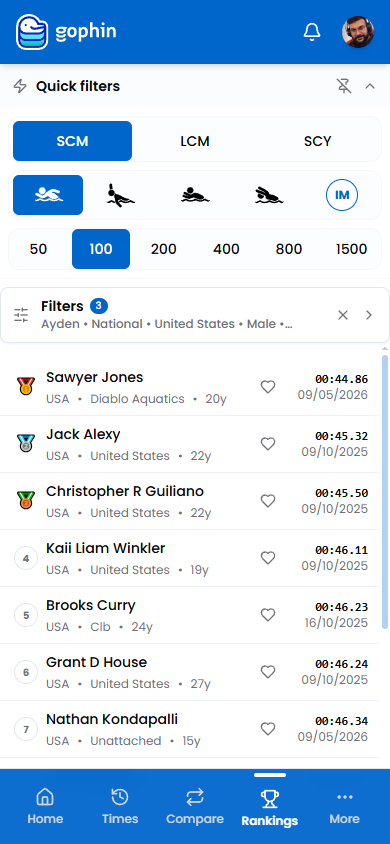
Tap Rankings in the menu. The screen opens with a filter bar at the top and the results list below.
Choose the event
Set the three things that define the race:
- Course: short course or long course
- Stroke: freestyle, backstroke, breaststroke, butterfly, or medley
- Distance: for example, 100
Set the group
Open Filters to pick gender and an age range, a single age or a wider band for a deeper list.
Choose the region and season
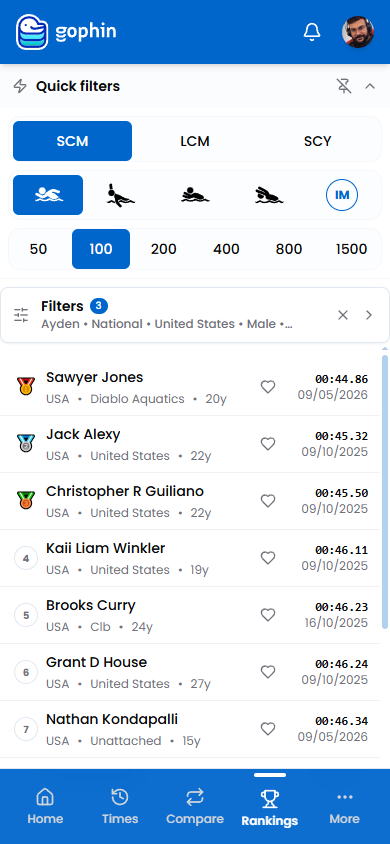
In Filters, set the scope (national, club, meet, or region), the country and region you want to rank within, and the season.
Set how many places to show
Choose a Top 50 view. It loads fast and still gives you a deep list. Avoid the "All" option for very large events, since it pulls a heavy query and can be slow.
Read the list
Find the swimmer’s row. Look at the times directly above and below to see the real gap to the next place. Often the difference between tenth and fortieth is only a second or two.
What's included
What's included
Rankings gives you the full set of views and filters, so you can slice every event, age group, and region without limits.
Tips
- Start from the event, not the name. Set course, stroke, and distance first, then narrow the group.
- A narrower age band gives a sharper read. A single age shows where a swimmer stands against true peers.
- Use the gap, not the number. The place matters less than the seconds to the next step up.
- Pair it with progress. A ranking is today. A swimmer’s own evolution is the trend.
Common questions
How do rankings work in Gophin?
Rankings order swimmers in one event, age group, and region by their best time in the selected season. You pick the course, stroke, distance, group, and region, then read where a swimmer sits and how close the next place is.
Are rankings free in Gophin?
Yes. Rankings gives you the full set of views and filters, so you can slice every event, age group, and region without limits.
Do I have to enter results to see rankings?
No. Results sync automatically from official competition databases, so there is nothing to enter by hand. You just set the event and group, and the list loads from the official records.